For some people, a healthy diet and rigorous exercise isn’t enough for dramatic weight loss. The Duke Center for Metabolic and Weight Loss Surgery may be the answer to help those at risk for serious weight-related health issues. Combining advanced surgical techniques with comprehensive counseling, we can help to welcome newfound freedom and long-term success.
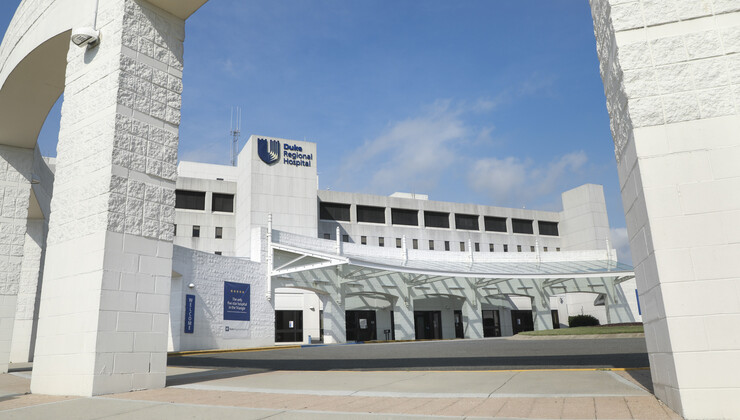
Duke Center for Metabolic and Weight Loss Surgery at Durham Regional Hospital is an American Society for Metabolic and Bariatric Surgery (ASMBS) Center of Excellence. The ASMBS Center of Excellence designation recognizes surgical programs with a demonstrated track record of favorable outcomes in bariatric surgery.
The program's outpatient clinic is located in Durham Regional's Health Services Center (407 Crutchfield Street, Durham, NC 27704). The phone number is 919-470-7000.
At Durham Regional Hospital, bariatric surgery patients are usually admitted to the general surgery unit, where the nursing staff is familiar with your needs and concerns. Durham Regional also has six inpatient suites on this unit specifically designed to meet the needs of weight loss surgery patients. In addition, Durham Regional has two operating rooms dedicated to serving bariatric patients.
Free regular and handicapped parking is available in front of the main entrance. Valet parking is also available Monday-Friday for $4. Ample waiting space for families is available on the third floor just inside the main entrance.
For more information, see our weight loss surgery content on DukeHealth.org.
Roux-en-Y gastric bypass is the most common procedure performed by the Duke Center for Metabolic and Weight Loss Surgery.
In this procedure, we create a new gastric pouch at the bottom of your esophagus, using about five percent of your stomach and sealing off the rest. We then connect this pouch to your small intestine.
Your stomach will still make important digestive juices that will mix in your intestine with food from your new, egg-sized stomach. In this way, you will still be able to receive the nutrients you need from food -- but your brain will get signals of fullness much faster, and the amount of food you can consume will become smaller.
This procedure is performed laparoscopically over 95 percent of the time.
Gastric banding is the second most common weight loss surgery performed by the Duke Center for Metabolic and Weight Loss Surgery.
This surgery has a similar goal to Roux-en-Y gastric bypass, in that it makes the stomach smaller to reduce the amount of food you take in and to help your brain generate a feeling of fullness after eating small portions of food.
But, instead of reducing the size of your stomach, the procedure does its job by suturing an adjustable band around the top portion of the stomach. The band can be adjusted with a specialized needle -- usually in a clinic visit -- so you can have it loosened or tightened as needed to reach your weight loss goals.
Gastric banding is considered the least invasive method of weight loss surgery. The procedure can easily be reversed if necessary.
Sleeve gastrectomy generates weight loss by restricting the amount of food that can be eaten by removing 85 percent or more of the stomach. What remains of the stomach is a narrow tube or sleeve, which connects to the intestines.
The nerves to the stomach and the outlet valve remain intact with the idea of preserving the functions of the stomach while drastically reducing the volume without bypassing the intestines or causing any gastrointestinal malabsorption.
It is currently indicated as an alternative to gastric banding for low weight individuals and as a safe option for higher weight individuals. It is occasionally considered a first step in a two-step surgical procedure for high-risk patients.
Duodenal switch is a procedure performed by removing the left portion of the stomach to limit food intake and then “switching” the small intestine around to alter the digestion process and limit food absorption.
You will feel full more quickly, which reduces the amount of food you eat and the number of calories consumed. Bypassing part of the intestine also means that your body will absorb fewer calories.
Durham Regional has welcomed a new surgical assistant to its Operating Rooms. Learn more about how the da Vinci Surgical System is being used for Weight Loss Surgery.